How MMA Judging Works: The 10-Point Must System Explained
MMA judges score each round on the 10-point must system, giving the winner 10 and the loser 9 or fewer, with damage ranked first, then effective striking and grappling.

MMA judging works on the 10-point must system: three judges score every round separately, the round winner gets 10 points and the loser gets 9 or fewer, and the round scores are added up at the end. Judges rank the round by damage first, then effective striking and grappling, and only use aggression and cage control when nothing else separates the fighters.
That sounds simple. The fights people argue about come from the details: what counts as damage, when a round is lopsided enough for a 10-8, why three trained judges watching the same fight can disagree, and why nobody has to explain a bad card afterward.
Here is how the system actually works under the Unified Rules of MMA, including the criteria rewrite the Association of Boxing Commissions approved in August 2025, and why decisions still go wrong.
- Scoring system
- 10-point must, three judges
- Top criterion
- Damage (ABC, August 2025)
- 10-8 round
- Significant damage required
- 10-8 frequency
- 4.4% to 8.7% after 2017 rules
- Defense scored
- Never, offense only
- Who picks judges
- Athletic commissions, not the UFC
What the 10-Point Must System Means
The "must" in 10-point must means the judge must give the round winner 10 points. The loser gets 9 for a normal round, 8 for a dominant round, 7 for a round that is nearly a stoppage. A 10-10 round is allowed but the Unified Rules say it is "generally reserved for use in partial rounds," meaning a round cut short by an accidental foul.
Each round is scored on its own. A fighter who wins round one by a hair and loses round two by a mile has still gone 1-1 on most cards, which is why a fight can feel one-sided to the crowd and still come out close on paper. After the final round, each judge adds up their own rounds. A three-round fight with no 10-8s ends 30-27, 29-28 or a draw.
Who the Judges Are and Who Picks Them
The UFC does not hire the judges. Every regulated fight falls under a state or national athletic commission, and the commission appoints the three judges, the referee and the inspectors. In Las Vegas that is the Nevada State Athletic Commission; in Abu Dhabi or Riyadh it is the local body or a visiting commission the promotion contracts with.
CBS Sports reported in 2022 that commissions operate independently, roughly 15 to 20 percent of them do not follow the 2017 Unified Rules in full, and judge selection is sometimes merit and sometimes connections. Longtime referee John McCarthy put the problem bluntly: "It's not good that a 10-8 in Nevada wouldn't be in California."
The Criteria, in Order: Damage First
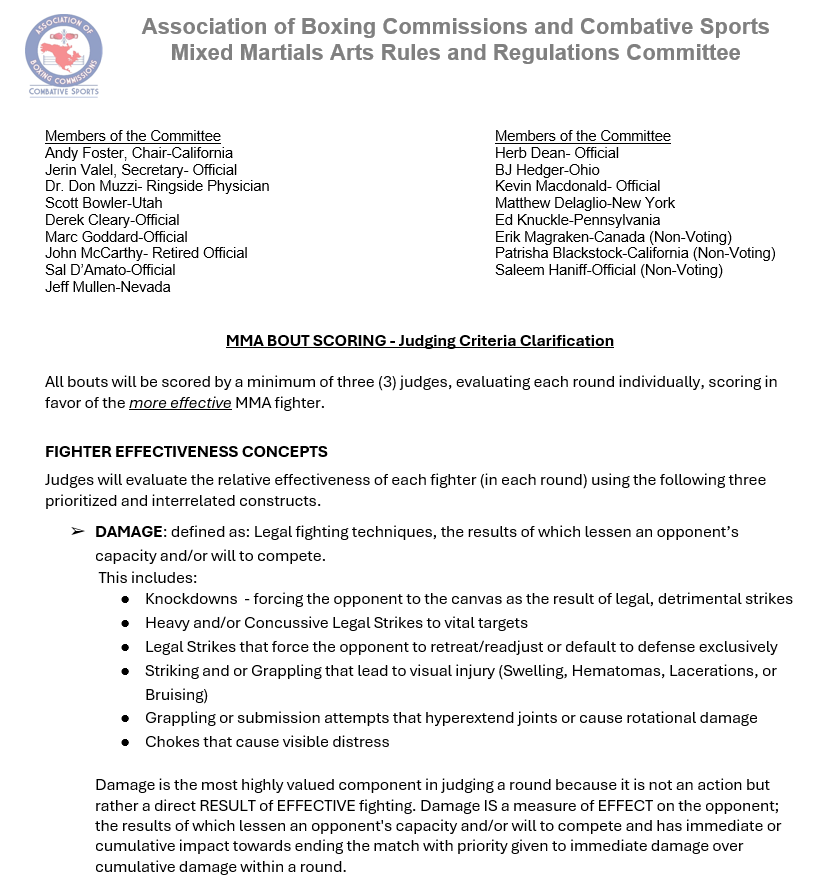
The scoring criteria are a priority list, not a checklist. Under the clarification the ABC approved at its August 2025 conference, the first thing a judge weighs is damage, defined as "legal fighting techniques, the results of which lessen an opponent's capacity and/or will to compete." The old 2017 wording tiptoed around the word; the 2025 version puts it on top.
Second is effective striking and grappling, which are weighted equally and measured by results. A strike counts when it produces damage. Grappling counts through "damage resulting from takedowns, reversals, submission attempts," not from holding position. Only if a judge cannot separate the fighters on those terms do they move to aggressiveness ("consistent offensive effort") and fighting area control ("dictating the pace, place and position"). The 2025 text also dropped the old tiered system for those tie-breakers: a judge now weighs whichever of the two "impacted the round in a more significant manner."
One line that surprises fans: "There is no scoring by the judges for defense." Slipping every punch for five minutes earns nothing. Only offense scores.
What Makes a Round 10-8
A 10-8 round under the 2025 criteria requires "significant damage" that could have finished the fight, possibly combined with dominance and duration. Damage is now mandatory; a fighter who controls an opponent on the mat for five minutes without hurting them does not earn a 10-8 anymore.
The 2017 rules introduced the "three Ds" that judges still talk about: impact, dominance and duration. Veteran judge trainer Rob Hinds explained the formula to Bloody Elbow when the rules took effect on January 1, 2017: one D present is likely a 10-9, two Ds means consider a 10-8, all three means score the 10-8 and the door opens for a 10-7. A 10-7 under the current text means a fighter was "overwhelming in both damage and domination throughout the duration of the round."
The 2017 change worked as intended. A 2021 Journal of Sports Analytics study by Paul Gift found the probability of a unanimous round winner getting a 10-8 roughly doubled, from 4.4 percent in 2001 to 2012 to 8.7 percent in 2017 to 2019, across 10,926 judge-round scores.
Unanimous, Split and Majority Decisions
Once the three cards are totaled, the labels are simple. A unanimous decision means all three judges had the same winner, even if their scores differ. A split decision means two judges picked one fighter and the third picked the other. A majority decision means two judges picked a winner and the third scored a draw.
Draws come in three forms too. A unanimous draw is all three cards even. A majority draw is two cards even and one with a winner. A split draw is one card for each fighter and one even.
The Pimblett vs Gordon fight at UFC 282 on December 11, 2022 shows how a unanimous decision can still be a controversy. All three judges, Doug Crosby, Chris Lee and Ron McCarthy, scored it for Paddy Pimblett, yet every media outlet logged by MMADecisions scored it for Jared Gordon, and the three judges agreed on only one round, the second. Unanimous does not mean obvious.
Why Decisions Go Wrong
Bad decisions usually come from one of four places. The first is the criteria themselves: damage is a judgment call, and a judge who weights visible marks (a cut, a swollen eye) will score differently from one who counts clean head strikes that leave no mark. The second is the view. Judges sit at three different cageside positions, and a fighter's back can hide an entire exchange from one of them.
The third is round-by-round math. A fighter can win two rounds narrowly and lose one badly and still take the fight 29-28 while absorbing far more total damage. The fourth is simple variance in the 10-8. Jan Blachowicz landed 64 total strikes to Israel Adesanya's 16 in round five at UFC 259 on March 6, 2021, two judges gave him a 10-8, and Dana White publicly disputed the cards. When the promoter and the officials disagree about what a dominant round looks like, fans have no chance of agreeing.
The Accountability Problem

Judges almost never have to explain a card. Commissions discourage officials from talking to the media, there is no standard penalty for a bad score, and most fans never learn whether a judge who turned in a widely mocked card worked the next event.
Coach Ray Longo summed up the frustration to CBS Sports: "Why are we protecting these guys? It's the only job where you have to kill somebody to get fired." The latest flashpoint came at UFC 332 in Salt Lake City on October 3, 2026, when all three judges scored Ismail Naurdiev over Marvin Vettori 29-28, handing Vettori his fifth straight loss while fans online called it a robbery. Whether the cards were right or wrong, nobody from the Utah commission had to say why.
The Rule Changes That Tried to Fix It
The Unified Rules have been patched twice in a decade. The 2017 revision, approved by the ABC in August 2016 and effective January 1, 2017, added the three Ds for 10-8 rounds, made clear that "merely holding a dominant position shall not be a primary factor," and told judges to assess results rather than actions.
The August 2025 clarification went further by naming damage as the top criterion in plain language, requiring damage for any 10-8, and simplifying the tie-breakers. The stated goal, as Combat Sports Law reported it, was "clearer and easier to understand language for fighters, officials and the public at large." Adoption still runs commission by commission, which is why you will see the old and new wording in use at the same time in different states.
How to Score a Fight Yourself

If you want to score like a judge rather than a fan, do four things. Score each round the moment it ends and do not revise it later. Ask who did more damage, and only if you cannot answer that ask who landed more and who threatened more with grappling. Ignore defense, ignore the crowd and ignore who looks tired unless the tiredness came from strikes. Reserve a 10-8 for a round where one fighter was hurt badly enough that you wondered about a stoppage.
Do that for a full card and your scores will land with the judges more often than you expect. The rounds where you still disagree are the ones where the criteria run out and a human has to pick.
I have sat cageside in Vegas enough to know the judges usually get the round right and still lose the room, because the system is designed to score rounds, not fights. That is the part fans refuse to accept. The 2025 damage rewrite is the best thing the ABC has done in a decade, since it finally says out loud what good judges were already doing. What it does not fix is accountability. Until a commission makes a judge stand at a microphone and walk through a 29-28, every bad card looks like corruption even when it is just a bad seat. My fix is boring: open scoring after round two, published per-round cards within the hour, and a public log of which judges keep landing outside the media consensus. Nevada could do all three tomorrow. If you are betting decisions, bet the fighter who does visible damage, because that is what the paper rewards now.
QUESTIONS PEOPLE ASK.
What is a 10-8 round in MMA?
A 10-8 round is one a fighter wins by a wide margin. Under the ABC's 2025 criteria it requires significant damage that could have ended the fight, possibly alongside dominance and duration. Control alone no longer qualifies. Judges use the three Ds from the 2017 rules as a guide: impact, dominance and duration. Two of the three means consider a 10-8, all three means score it.
What is the difference between a split decision and a majority decision?
In a split decision two judges score the fight for one fighter and the third scores it for the other. In a majority decision two judges pick the same winner and the third scores the fight a draw. A unanimous decision means all three judges have the same winner, even if their point totals differ. Draws can also be unanimous, majority or split.
Does cage control win rounds in MMA?
Only as a tie-breaker. The Unified Rules rank damage first, then effective striking and grappling. Fighting area control and aggressiveness only come into play when a judge cannot separate the fighters on those terms. Walking an opponent down or holding them against the fence without hurting them does not win a round by itself under the current criteria.
Why do MMA judges get decisions wrong so often?
Several reasons stack up. Damage is a judgment call, judges sit at three different angles and miss exchanges, and a fighter can win two close rounds while losing one badly and still take the fight. Commissions also apply the 10-8 differently from state to state, and judges rarely have to explain a card, so the same mistakes repeat without correction.
Who chooses the judges for UFC fights?
The athletic commission regulating the event, not the UFC. In Las Vegas the Nevada State Athletic Commission assigns judges, referees and inspectors. For international cards the local body or a contracted commission does it. The promotion has no formal say, which is why Dana White complains about scorecards but cannot remove a judge from an event.
- ABC: MMA Scoring Criteria Clarification, July 2025 (PDF)
- Combat Sports Law: Damage! Brand New MMA Judging Criteria Approved
- Bloody Elbow: Two top judges explain MMA's new 10-8 scoring criteria
- Journal of Sports Analytics: The impact of new judging criteria on 10-8 scores in MMA
- CBS Sports: Why scoring MMA fights continues to cause confusion and lack accountability
- Yahoo Sports / MMA Junkie: UFC 282 scorecards for Pimblett vs Gordon
- EssentiallySports: Robbery controversy at UFC 332 after Vettori loss
- Wikipedia: UFC 332
Figures in this piece come from the sources above; purses, deals and net worth totals are estimates unless a commission or the fighter disclosed them. Spotted an error? Send a correction.